
Roulette stands out as one of the most popular casino games because it offers both simple and complex betting options for every type of player. The spinning wheel and the bouncing ball create excitement, but your success depends on understanding what bets you can make and how much they pay out. Each bet type in roulette comes with different odds and payouts, ranging from even-money bets that cover nearly half the wheel to single-number bets that pay 35 to 1.
You have dozens of ways to place your chips on a roulette table, and each choice affects your chances of winning. Some bets cover large sections of the wheel and win more often but pay less. Other bets focus on specific numbers or small groups and rarely win but offer bigger payouts when they do. The key is knowing which bet matches your playing style and budget.
This guide breaks down every type of roulette bet you can make, from basic outside bets to advanced call bets. You’ll learn exactly what each bet pays, your actual odds of winning, and how different roulette versions change your chances. Whether you’re new to the game or want to expand your betting options, understanding these basics helps you make smarter decisions at the table.
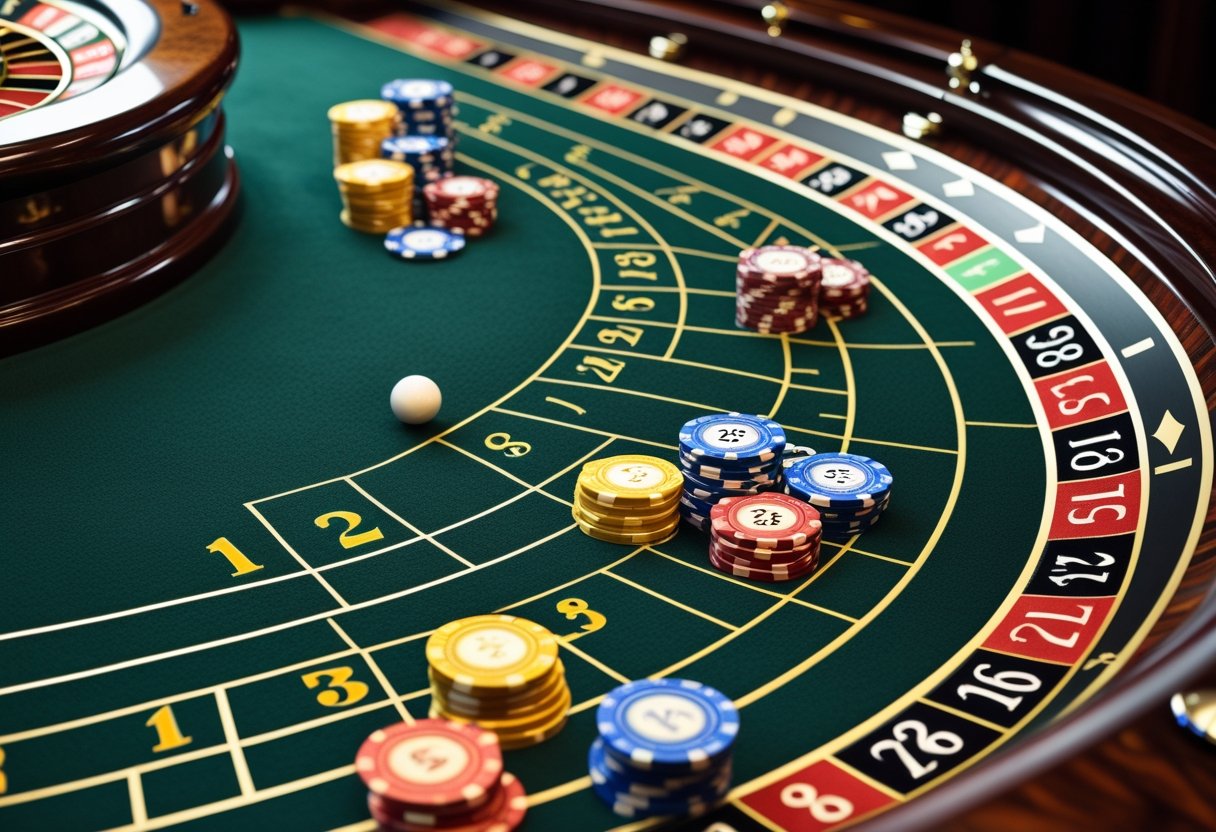
Understanding the Roulette Table and Wheel
The roulette table and wheel work together as the two main parts of the game. The table shows where you place your bets, while the wheel determines the winning number when the roulette ball lands in a pocket.
Roulette Table Layout
The roulette table layout consists of a betting grid with numbers and additional betting areas. You’ll find numbers 1-36 arranged in three columns of 12 rows each. The numbers alternate between red and black colors.
At the top of the grid sits the green zero (or double zero on American tables). Along the sides and bottom of the number grid, you’ll see boxes for outside bets. These include red/black, odd/even, high/low, dozens, and columns.
The table uses a specific color scheme to help you identify bets quickly. Red and black match the wheel colors, while green marks the zero pockets. Outside betting areas typically have clear labels showing the type of bet and payout ratio.
Roulette Wheel Structure
The roulette wheel contains numbered pockets where the ball can land. Each pocket has a number from 0-36 (plus 00 on American wheels). The pockets alternate between red and black, except for the green zero pockets.
The numbers on the wheel don’t run in order. They follow a specific pattern designed to distribute odd, even, red, and black numbers evenly around the wheel. This arrangement helps ensure random outcomes.
The wheel spins in one direction while the dealer releases the ball in the opposite direction. When the ball loses momentum, it falls into one of the numbered pockets. That number becomes the winning result for that round.
Single Zero vs Double Zero
European roulette uses a single zero wheel with 37 total pockets (numbers 1-36 plus one zero). This gives the house an edge of 2.7%. Your odds are better because there’s one less pocket for the ball to land in.
American roulette adds a double zero pocket, creating 38 total pockets. The extra pocket increases the house edge to 5.26%. This nearly doubles the casino’s advantage compared to European roulette.
The extra zero pocket affects all your bets equally. When you bet on red, for example, you have 18 ways to win on a European wheel versus 19 ways to lose. On an American wheel, you still have 18 ways to win but now 20 ways to lose.

Types of Roulette Bets
Roulette offers multiple bet categories that differ in risk, payout, and table placement. Inside bets cover specific numbers with higher payouts, outside bets group larger number sets with better odds, call bets use announced number patterns, and side bets add optional wagers beyond standard options.
Inside Bets Overview
Inside bets are wagers placed directly on the numbered grid of the roulette table. These bets cover fewer numbers and offer higher payouts compared to outside bets.
Straight Up bets cover a single number and pay 35 to 1. You place your chip directly on any number including zero.
Split bets cover two adjacent numbers and pay 17 to 1. You position your chip on the line between two numbers.
Street bets cover three numbers in a horizontal row and pay 11 to 1. Place your chip on the outer edge of the row.
Corner bets cover four numbers that meet at one corner and pay 8 to 1. Your chip goes on the intersection point where all four numbers meet.
Double Street (or line) bets cover six numbers across two adjacent rows and pay 5 to 1. You place your chip where two rows meet on the outer edge.
Outside Bets Overview
Outside bets are positioned on the outer sections of the betting layout and cover larger groups of numbers. These roulette bet types win more frequently but offer lower payouts.
Red/Black bets cover all 18 red or 18 black numbers and pay 1 to 1. This is one of the most popular outside bets.
Odd/Even bets also cover 18 numbers and pay 1 to 1. You win if the ball lands on your chosen parity.
High/Low bets divide the table into numbers 1-18 (low) or 19-36 (high) and pay 1 to 1.
Dozen bets cover 12 consecutive numbers in groups (1-12, 13-24, or 25-36) and pay 2 to 1.
Column bets cover one of three vertical columns of 12 numbers each and pay 2 to 1. You place chips in the box at the bottom of your chosen column.
Call and Announced Bets
Call bets and announced bets refer to specific number patterns common in European roulette betting. Call bets let you announce your wager verbally, while announced bets require you to place chips before the spin.
Voisins du Zero (neighbors of zero) covers 17 numbers between 22 and 25 on the wheel. This bet requires nine chips spread across splits and corners.
Tiers du Cylindre covers 12 numbers opposite zero on the wheel. You need six chips to cover this section with split bets.
Orphelins covers the eight numbers not included in the two previous bets. This requires five chips placed on specific numbers.
Neighbors bets cover a number plus the two numbers on each side of it on the physical wheel. You announce which number you want plus its neighbors.
Side Bets in Roulette
Side bets are optional wagers offered at certain roulette tables beyond standard betting options. These bets vary by casino and roulette variant.
Basket Bet (American roulette only) covers 0, 00, 1, 2, and 3, paying 6 to 1. This bet has worse odds than other inside bets with a house edge of 7.89%.
Final Bets cover all numbers ending in the same digit. A final 4 bet includes 4, 14, 24, and 34.
Red/Black Splits combine color bets with specific number coverage for varied payouts.
Some online casinos offer progressive side bets where you can win jackpots based on consecutive winning spins on specific bet types. These side bets typically have higher house edges than standard roulette bets.

Inside Bets Explained
Inside bets cover specific numbers or small groups of numbers on the main betting grid. These wagers offer higher payouts than outside bets but come with lower odds of winning since you’re covering fewer numbers on the wheel.
Straight-Up Bet
A straight-up bet is the simplest inside bet you can make. You place your chip directly on any single number from 0 to 36.
This bet covers just one number, giving you the lowest odds but the highest payout of all roulette bets. The straight bet pays 35 to 1 when it wins. On a European wheel with 37 pockets, your odds of winning are 1 in 37, which equals about 2.7%. On an American wheel with 38 pockets, the odds drop slightly to 1 in 38, or about 2.6%.
If you wager $10 on number 17 and it hits, you receive $350 in winnings plus your original $10 stake back for a total of $360. The high payout makes straight-up bets attractive, but you should expect longer stretches between wins compared to other bet types.
Split Bet
A split bet lets you cover two adjacent numbers with a single chip. You place your chip on the line between any two touching numbers on the layout.
The two numbers can be next to each other horizontally or vertically. For example, you could place a split bet on 14/17 or 22/23. This bet pays 17 to 1 when either number wins. Your odds improve to 2 in 37 on European roulette (about 5.4%) or 2 in 38 on American roulette (about 5.3%).
Split bets give you twice the coverage of a straight-up bet while still maintaining a strong payout. A $10 split bet returns $170 in winnings plus your $10 stake if successful.
Street Bet
A street bet covers three consecutive numbers in a horizontal row. You place your chip at the edge of the row to indicate you’re betting on all three numbers.
Common street bets include 1-2-3, 13-14-15, or 34-35-36. This wager pays 11 to 1 when any of the three numbers hits. Your winning odds increase to 3 in 37 (about 8.1%) on European wheels or 3 in 38 (about 7.9%) on American wheels.
A $10 street bet returns $110 in winnings plus your original stake. Streets offer a middle ground between the high-risk straight-up bet and lower-paying outside bets.
Corner Bet
A corner bet covers four numbers that meet at one intersection point. You place your chip at the exact corner where all four numbers touch.
Examples include 10-11-13-14 or 25-26-28-29. The corner bet pays 8 to 1 for any winning number. You have 4 in 37 chances on European roulette (about 10.8%) or 4 in 38 on American roulette (about 10.5%).
With a $10 corner bet, you collect $80 in winnings plus your $10 stake back. Corner bets provide decent coverage while maintaining a reasonable payout ratio compared to outside bets that pay 1 to 1 or 2 to 1.
Advanced Inside Bets
Beyond basic inside bets, several advanced options let you cover specific number combinations with unique placements and payouts. Line bets expand your coverage across two rows, basket bets target numbers at the table’s top, and special French-style wagers group numbers by wheel position rather than table layout.
Line Bet (Double Street Bet)
A line bet covers six numbers across two adjacent rows on the roulette table. You place your chip at the outer edge where the two rows meet, spanning both streets at once.
This bet typically pays 5 to 1 if successful. On a European wheel with 37 pockets, you have a 6 in 37 chance of winning, which equals about 16.2%. On an American wheel with 38 pockets, your odds drop slightly to 6 in 38, or roughly 15.8%.
Example: You can bet on numbers 1-2-3 and 4-5-6 simultaneously by placing your chip between these two rows. If any of these six numbers hit, you receive five times your original stake plus your bet back.
The line bet offers more coverage than a street while maintaining a respectable payout. It sits between corner bets and outside bets in terms of risk and reward.
Basket Bet
The basket bet is unique to American roulette and covers five numbers: 0, 00, 1, 2, and 3. You place your chip at the corner where the zero boxes meet the first row of numbers.
This bet typically pays 6 to 1 if successful. However, it carries the worst roulette house edge of any standard bet at approximately 7.89%. For comparison, most other bets on an American wheel have a house edge of about 5.26%.
Why the higher house edge? The payout doesn’t match the true odds. With five numbers covered out of 38 total, the fair payout would be 33 to 5 (or 6.6 to 1), but casinos only pay 6 to 1.
Most experienced players avoid the basket bet because of this unfavorable edge. You’re better off making other inside or outside bets that give you better value for your wager.
Special Bets: Jeu Zéro and Orphelins
French roulette includes special call bets that group numbers by their position on the wheel rather than the table layout. These bets require multiple chips placed across different spots.
Jeu Zéro (Zero Game) covers seven numbers close to zero on the wheel: 12, 35, 3, 26, 0, 32, and 15. You need four chips to complete this bet, with specific placements including a straight up on 26 and three splits covering the other numbers. This bet is only available on European wheels.
Orphelins (Orphans) covers eight numbers that sit in two wheel segments not included in other common call bets. The numbers are 1, 20, 14, 31, 9, 17, 34, and 6. You need five chips: one straight up on 1 and four splits for the remaining numbers.
These special bets appear on French roulette tables with a racetrack layout. They let you bet on wheel sections quickly without placing multiple chips individually. The payouts follow standard roulette payout chart values based on whether you hit a straight up or split within the combination.
Outside Bets Detailed
Outside bets cover larger groups of numbers on the roulette table and offer better odds of winning compared to inside bets. These wagers pay 1:1 or 2:1 and include options like red or black, odd or even, high or low, columns, and dozens.
Red or Black
You can bet on whether the ball will land on a red or black number. This is one of the most popular options in any roulette betting guide because it offers nearly a 50/50 chance of winning.
The payout is 1:1, meaning you double your money on a win. On a European wheel with 37 pockets, you have 18 red numbers and 18 black numbers, giving you a 48.65% chance of winning. The American wheel drops this to 47.37% because of the extra zero pocket.
Neither bet covers the green zero (or double zero on American wheels). If the ball lands on zero, both red and black bets lose.
Odd or Even
This bet lets you wager on whether the winning number will be odd or even. The structure mirrors red or black bets in terms of payout and probability.
You receive a 1:1 payout when you win. There are 18 odd numbers and 18 even numbers on the wheel. Your odds are 48.65% on European roulette and 47.37% on American roulette.
Zero is neither odd nor even, so your bet loses if the ball lands there. This makes odd or even one of the best roulette bets for beginners who want consistent action.
High or Low
High or low bets divide the wheel into two equal groups. You bet on numbers 1-18 (low) or 19-36 (high).
The payout remains 1:1, matching the other even-money outside bets. Each group contains 18 numbers, giving you the same 48.65% chance on European wheels and 47.37% on American wheels. Zero doesn’t count as either high or low.
This bet works well when combined with other outside bets in your strategy. Many players use high or low as part of their pattern-based betting systems.
Column and Dozen Bets
Column bets cover one of three vertical columns on the betting layout, with each column containing 12 numbers. Dozen bets group numbers into three sets: 1-12 (first dozen), 13-24 (second dozen), or 25-36 (third dozen).
Both bet types pay 2:1, giving you three times your stake when you win. Your winning probability is 32.43% on European roulette and 31.58% on American roulette.
| Bet Type | Numbers Covered | Payout | European Odds | American Odds |
|---|---|---|---|---|
| Column | 12 numbers | 2:1 | 32.43% | 31.58% |
| Dozen | 12 numbers | 2:1 | 32.43% | 31.58% |
Column bets are marked at the bottom of the betting grid with boxes labeled “2 to 1.” Dozen bets appear in boxes marked “1st 12,” “2nd 12,” and “3rd 12” along the side of the table. Neither bet type includes zero, so the ball landing on zero means you lose.
Call Bets and Wheel Sectors
Call bets cover specific sections of the roulette wheel rather than following the table layout. These announced bets appear primarily in European and French roulette variations, allowing you to bet on groups of neighboring numbers with a single declaration.
Voisins du Zéro
Voisins du Zéro means “neighbors of zero” and covers 17 numbers surrounding the green zero on the wheel. This bet spans from 22 to 25, passing through zero in the middle section.
You need 9 chips to complete this bet. The chips get placed as follows:
| Numbers | Chips | Bet Type |
|---|---|---|
| 0, 2, 3 | 2 | Trio |
| 4, 7 | 1 | Split |
| 12, 15 | 1 | Split |
| 18, 21 | 1 | Split |
| 19, 22 | 1 | Split |
| 25, 26, 28, 29 | 2 | Corner |
| 32, 35 | 1 | Split |
Your odds of winning sit at 45.9%, making this the largest call bet available. The highest payout comes from hitting 0, 2, or 3, which returns 24 units total.
Tiers du Cylindre
Tiers du Cylindre translates to “thirds of the wheel” and covers 12 numbers on the opposite side from Voisins du Zéro. You place 6 chips as split bets across these numbers: 5/8, 10/11, 13/16, 23/24, 27/30, and 33/36.
This bet gives you a 32.4% chance of winning. Each split pays 17 to 1, returning 18 units on any winning number.
The section covers exactly one-third of the wheel. All six bets use the same structure, with one chip on each split bet.
Orphelins
Orphelins means “orphans” and covers the 8 remaining numbers not included in Voisins du Zéro or Tiers du Cylindre. These numbers appear in two separate wheel sections.
You need 5 chips for this bet:
- 1 chip straight on number 1
- 1 chip split on 6/9
- 1 chip split on 14/17
- 1 chip split on 17/20
- 1 chip split on 31/34
Your winning probability is 21.6%. Number 1 offers the highest payout at 36 units total. Note that 17 appears in two different splits, making it the only overlapping number in this call bet.
Advanced Announced Bets
Neighbor bets place chips on your chosen number plus two numbers on each side of it on the wheel. You need 5 chips total for this variable bet. For example, calling “32 and the neighbors” covers 26, 0, 32, 15, and 19.
Final bets cover all numbers ending in your selected digit. A final 4 bet includes 4, 14, 24, and 34, requiring 4 chips. Finals 7, 8, and 9 only need 3 chips since fewer numbers end in those digits.
Jeu Zéro is a smaller version of Voisins du Zéro, using just 4 chips to cover 7 numbers: 12, 35, 3, 26, 0, 32, and 15. This gives you an 18.9% chance of winning with less investment than the full Voisins bet.
Roulette Odds and Payouts
Roulette payouts and odds are directly linked to how many numbers your bet covers. Bets on single numbers pay significantly more than bets on larger groups, while your chances of winning increase as you cover more numbers.
Roulette Payout Chart
A payout chart shows you exactly what you’ll win for each bet type. Inside bets pay higher amounts but cover fewer numbers. Outside bets pay less but cover more numbers.
Inside Bets
| Bet Type | Numbers Covered | Payout |
|---|---|---|
| Straight Up | 1 | 35 to 1 |
| Split | 2 | 17 to 1 |
| Street | 3 | 11 to 1 |
| Corner | 4 | 8 to 1 |
| Double Street | 6 | 5 to 1 |
Outside Bets
| Bet Type | Numbers Covered | Payout |
|---|---|---|
| Red/Black | 18 | 1 to 1 |
| Odd/Even | 18 | 1 to 1 |
| High/Low | 18 | 1 to 1 |
| Dozen/Column | 12 | 2 to 1 |
If you bet one chip on a straight-up number and win, you receive 35 chips plus your original bet back.
Odds for Each Bet Type
Your odds of winning depend on how many numbers your bet covers and which roulette wheel you play. European roulette has 37 total numbers, while American roulette has 38.
On a European wheel, a straight-up bet has a 2.70% chance of winning. A red or black bet gives you a 48.65% chance. The extra zero in American roulette reduces all winning percentages.
European Roulette Win Rates:
- Straight Up: 2.70%
- Split: 5.41%
- Street: 8.11%
- Red/Black: 48.65%
- Dozen: 32.43%
American Roulette Win Rates:
- Straight Up: 2.63%
- Split: 5.26%
- Street: 7.89%
- Red/Black: 47.37%
- Dozen: 31.58%
These percentages show why outside bets win more frequently than inside bets.
Influence of Roulette Variants on Odds
The type of roulette wheel you play changes your odds. European roulette uses one zero (0), while American roulette adds a double zero (00).
That single extra pocket makes American roulette less favorable. French roulette uses the same wheel as European but adds special rules. The la partage rule returns half your even-money bet if the ball lands on zero.
This rule cuts the house edge in half on red/black, odd/even, and high/low bets. Some French tables also offer the en prison rule, which gives you another spin instead of losing half your bet.
Always choose European or French roulette when available.
House Edge Impact
The house edge is the casino’s mathematical advantage over you. It exists because payouts are slightly lower than the true odds of winning.
European roulette has a 2.70% house edge on almost all bets. American roulette has a 5.26% house edge because of the extra zero. The basket bet in American roulette (covering 0, 00, 1, 2, 3) has an even worse house edge.
French roulette with la partage drops the house edge to 1.35% on even-money bets. This is the lowest house edge you’ll find in roulette.
The house edge applies to every spin. No betting pattern or system can reduce it.
Comparing Roulette Variants
Different roulette variants offer distinct wheel layouts, house edges, and rules that directly impact your chances of winning. The three main versions are European, American, and French roulette, with each providing different odds based on the number of zero pockets on the wheel.
European Roulette Overview
European roulette uses a wheel with 37 pockets numbered 1 to 36, plus a single green zero. This single zero gives the game a house edge of 2.70%, making it more favorable than American roulette.
When you place an even-money bet like red or black, you have 18 winning outcomes, 18 losing outcomes, and one zero that favors the house. This gives you a 48.64% chance to win on these bets.
Standard Payouts in European Roulette:
- Straight-up (single number): 35 to 1
- Split (2 numbers): 17 to 1
- Street (3 numbers): 11 to 1
- Corner (4 numbers): 8 to 1
- Red/Black, Even/Odd, High/Low: 1 to 1
European roulette is the most common version at online casinos and land-based casinos outside the United States. It provides a good balance between simple rules and fair odds.
American Roulette Overview
American roulette features 38 pockets on the wheel: numbers 1 to 36, plus both 0 and 00. The extra double zero pocket increases the house edge to 5.26%, nearly double that of European roulette.
This higher house edge means you lose more money over time. If you play 100 spins at $10 per spin, your expected loss in American roulette is around $52 compared to about $27 in European roulette.
The payouts for winning bets remain the same as European roulette, but your chances of winning decrease because of the extra zero. On even-money bets, you now face two house pockets instead of one.
American roulette is the standard version found in most U.S. casinos. Many players choose it simply because it’s the only option available at their local casino.
French Roulette Features
French roulette uses the same 37-pocket wheel as European roulette but includes special rules that lower the house edge on even-money bets. The La Partage rule returns half your stake if you lose an even-money bet when the ball lands on zero.
The En Prison rule gives you another option when zero hits. Your bet gets locked for the next spin, and if it wins on that second spin, you get your original stake back.
These rules reduce the house edge to just 1.35% on even-money bets, which is the lowest you can find in any roulette variant. If you bet $100 on black and the ball lands on zero, La Partage means you only lose $50 instead of the full amount.
French roulette is less common than European roulette and often appears at higher-limit tables in land-based casinos. Many online roulette sites now offer French roulette, making it easier to access.
Online vs Land-Based Casino Roulette
Roulette online gives you access to multiple roulette variants from one location, including European, American, and French versions. You can also find free roulette games to practice before playing with real money.
Online casinos offer modern variants like Lightning Roulette with random multipliers and Multi-Wheel Roulette that spins multiple wheels at once. These options aren’t typically available at land-based casinos.
Land-based casinos provide a physical experience with real dealers and other players around the table. The selection of variants depends on your location, with U.S. casinos mainly offering American roulette while European casinos focus on European and French versions.
Online roulette typically has lower minimum bets, sometimes starting at $1 or less. Land-based casinos usually require higher minimums, especially for French roulette tables.
Roulette Betting Strategies and Tips
While roulette is a game of chance, certain strategies help you manage your bets and bankroll more effectively. The right approach won’t change the odds, but it can structure your gameplay and potentially extend your playing time.
Popular Roulette Strategies
The Martingale is the most well-known roulette betting strategy. You double your bet after each loss and return to your original bet after a win. This approach works best on even-money bets like red/black or odd/even. The main risk is hitting table limits or running out of funds during a losing streak.
The Fibonacci strategy uses a number sequence where each bet equals the sum of the two previous bets (1, 1, 2, 3, 5, 8, 13). You move one step forward after a loss and two steps back after a win. This method increases bets more slowly than Martingale but still requires a healthy bankroll.
The D’Alembert system is simpler. You increase your bet by one unit after a loss and decrease it by one unit after a win. This creates a more balanced approach that doesn’t escalate as quickly as other systems.
The James Bond strategy involves placing specific bets to cover more than half the table. You place 70% of your stake on high numbers (19-36), 25% on six numbers (13-18), and 5% on zero as insurance.
Best Bets in Roulette
Even-money outside bets offer the highest probability of winning at 48.65% on a European wheel. These include red/black, odd/even, and high/low (1-18 or 19-36). Each pays 1:1 and gives you nearly a coin-flip chance on each spin.
Dozens and columns bets cover 12 numbers each with a 32.43% win rate and 2:1 payout. These provide a middle ground between safety and returns. You can combine two dozens or columns to cover 24 numbers, though this lowers your payout.
Always choose European roulette over American when possible. The single zero gives you a 2.70% house edge compared to 5.26% on American wheels with double zero. This difference significantly impacts your long-term results.
Avoid single-number straight bets unless you’re playing for entertainment. The 35:1 payout looks attractive, but your 2.70% chance of winning makes these high-risk propositions.
Roulette Tips for Players
Set win and loss limits before you start playing. Walk away when you hit either threshold, whether you’re up or down. This discipline protects your bankroll and prevents emotional decisions.
Each spin is independent. The ball has no memory of previous results. If red hits five times in a row, black isn’t “due” to appear. This gambler’s fallacy costs players real money.
Start with outside bets when learning how to play roulette. These frequent wins help you understand the game flow and table dynamics without depleting your funds quickly. Move to inside bets only when you’re comfortable with the basics.
Take advantage of casino bonuses for roulette play, but read the terms carefully. Many bonuses have wagering requirements that make them less valuable than they first appear.
Bankroll Management Advice
Divide your total bankroll into session amounts. Never bring your entire budget to one session. A good rule is limiting each session to 5% of your total roulette funds.
Size your bets at 1-2% of your session bankroll. If you have $200 for a session, your bets should range from $2-4. This approach gives you enough spins to weather normal variance without going broke quickly.
| Bankroll | Session Amount | Bet Size | Number of Bets |
|---|---|---|---|
| $1,000 | $50 | $1 | 50 |
| $2,000 | $100 | $2 | 50 |
| $5,000 | $250 | $5 | 50 |
Track your wins and losses across sessions. This record shows your actual performance and helps you adjust your strategy. Many players overestimate their wins and underestimate their losses without concrete data.
Never chase losses by increasing bet sizes beyond your plan. This desperation play leads to faster bankroll depletion and poor decision-making. Stick to your predetermined betting limits regardless of short-term results.
Frequently Asked Questions
Roulette bets divide into inside and outside categories, each offering different payouts based on how many numbers they cover. European roulette provides better odds than American roulette due to having one less zero on the wheel.
What are the various types of bets available in casino roulette, and how do they differ?
Inside bets are placed directly on the numbered grid and cover fewer numbers for higher payouts. A straight up bet covers one number and pays 35 to 1. A split bet covers two adjacent numbers and pays 17 to 1.
Street bets cover three numbers in a row and pay 11 to 1. Corner bets cover four numbers where they meet and pay 8 to 1. Double street bets cover six numbers across two rows and pay 5 to 1.
Outside bets cover larger groups of numbers with lower payouts but higher winning chances. Red/black, odd/even, and high/low bets each cover 18 numbers and pay 1 to 1. Dozen and column bets cover 12 numbers and pay 2 to 1.
The main difference between these bet types is risk versus reward. Inside bets win less often but pay more when they hit. Outside bets win more frequently but offer smaller returns.
How are the payouts calculated for different roulette bets?
Payouts are based on how many numbers your bet covers. The fewer numbers you bet on, the higher your payout will be. The calculation follows a simple pattern where the payout reflects the true odds minus the house advantage.
A straight up bet covers 1 number out of 37 on a European wheel. The true odds are 36 to 1, but the casino pays 35 to 1. This difference creates the house edge.
For a split bet covering 2 numbers, you have 2 chances out of 37 to win. The payout is 17 to 1. A corner bet covering 4 numbers pays 8 to 1.
Outside bets follow the same principle. Red/black bets cover 18 numbers out of 37, giving you nearly 50% odds. The payout is 1 to 1 because you have close to even chances of winning.
Can you explain the odds associated with the different betting options in roulette?
Your odds depend on the type of wheel you play and which bet you make. European roulette has 37 total numbers, while American roulette has 38 numbers due to the extra double zero.
On a European wheel, a straight up bet has a 2.70% chance of winning. On an American wheel, that same bet has only a 2.63% chance. The extra zero reduces your winning probability without changing the payout.
Red/black, odd/even, and high/low bets have a 48.65% winning chance on European wheels. On American wheels, these bets drop to 47.37%. The house edge on European roulette is 2.70%, while American roulette has a 5.26% house edge.
Dozen and column bets win 32.43% of the time on European wheels and 31.58% on American wheels. Inside bets like corners win 10.81% of the time on European wheels and 10.53% on American wheels.
What does betting on ‘1st 12’, ‘2nd 12’, or ‘3rd 12’ signify in the game of roulette?
These markings refer to dozen bets, which cover 12 consecutive numbers on the roulette layout. The 1st 12 covers numbers 1 through 12. The 2nd 12 covers numbers 13 through 24.
The 3rd 12 covers numbers 25 through 36. Each dozen bet pays 2 to 1 when it wins. You can place chips in the boxes marked “1st 12,” “2nd 12,” or “3rd 12” on the table layout.
These bets do not include zero or double zero. If the ball lands on zero, all dozen bets lose. You can bet on multiple dozens at the same time to cover more numbers.
Dozen bets offer a balance between risk and reward. They win roughly one-third of the time and provide moderate payouts compared to even-money bets.
Could you provide an overview of a roulette payout chart?
A payout chart shows what you win based on your bet type and how many chips you wager. Straight up bets pay 35 times your stake. If you bet 1 chip on a single number and win, you receive 35 chips plus your original bet back.
Split bets pay 17 to 1, street bets pay 11 to 1, and corner bets pay 8 to 1. Double street bets pay 5 to 1. The basket bet on American wheels pays 6 to 1 but has worse odds than other inside bets.
Outside bets have different payout structures. Red/black, odd/even, and high/low all pay 1 to 1, meaning you double your money when you win. Dozen and column bets pay 2 to 1, tripling your original wager.
If you bet multiple chips, multiply the base payout by your chip amount. Betting 5 chips on a straight up number wins you 175 chips (35 x 5). Betting 5 chips on red wins you 5 chips (1 x 5).
What are considered the most strategic bets to make in roulette for favorable odds?
Red/black, odd/even, and high/low bets are your best options for longer play sessions. These even-money bets win close to 50% of the time on European wheels. They create less volatility in your bankroll compared to inside bets.
Dozen and column bets offer a middle ground between safety and excitement. They win about one-third of the time and pay 2 to 1. These bets work well if you want bigger payouts than even-money bets without taking excessive risk.
Always choose European roulette over American roulette when possible. The single zero wheel cuts the house edge nearly in half. This difference significantly impacts your results over time.
Avoid the basket bet on American roulette tables. This bet covers 0, 00, 1, 2, and 3, and has worse odds than other inside bets. Straight up bets carry high risk due to low winning frequency but can be entertaining if you play with small amounts.
No betting strategy can overcome the house edge. Your best approach is
